Tweet
Saturday, February 28, 2009 | By: Shital Pradhan

Another feather in the raven crown of ‘Small but Beautiful’ Sikkim 14 tourism awards in one decade, 25 percent increase in tourism flow

FROM SIKKIM EXPRESS

BY PRANIL SUBBA

GANGTOK, February 27: ‘Small but Beautiful’ Sikkim has not only bagged yet another tourism award but this Himalayan State has also cemented its position as a most sought after destination in the nation.
This actuality is reflected strongly in the phenomenal growth in terms of tourism flow to Sikkim in 2008 and another national tourism award from Ministry of Tourism that was given on February 24.
The award, national tourism award 2007-08 as the Best State for tourism related programmes was received by the State tourism secretary SBS Bhadauria from Union Home minister P Chidambaram in the presence of Union Tourism minister Ambika Soni at the awards function held in New Delhi.

Speaking to media here today, Mr. Bhadauria said that this was the 14th major award won by Sikkim in the field of tourism in the last decade due to the dedication and enthusiasm of the State government which had been instrumental in achieving the goals.
“The award proves Sikkim has been firmly placed in the global tourism scene and we have created our own brand called Sikkim”, said the tourism secretary. He said that it was a proud moment for the State with the unyielding zeal and dedication of all stakeholders and the firm support of the government. We hope to achieve as the best tourism destination in the country, he added.
It is to be mentioned here that Sikkim has bagged the best tourism performing State in the North east region for six consecutive years in the past from the MoT.
Recently Sikkim have also bagged the best eco-tourism destination, most picturesque destination, best community based tourism, emerging tourism state, best tourism State for adventure from reputed organizations at the national level.
The tourism secretary said that around 4.5 lakh domestic tourists and 23,000 foreign tourists visited the State in 2008. He said this was about 25 per cent increase from that of the previous year. In the previous year, around 3.8 domestic tourists and 18,000 foreigners had visited Sikkim.
Despite the bandhs and the disturbances in the neighbouring regions, this was a record for the state, Mr. Bhadauria said. He also said that as per the analysis, the quality of tourism had also increased manifolds and there was now ‘no off-season’ with visitors coming to the State throughout the year.
The tourism secretary claimed that Sikkim today was the most sought after destination for domestic as well as foreign tourists coming to the country and had made significant presence in the tourism map. The destinations and infrastructure have been developed to a great extent within a short period of time making Sikkim greatly attractive to the visitors, he added.
Mr. Bhadauria informed that a State tourism policy was in the final stages of preparation and the final policy would be put forward to the government in the first quarter of the coming fiscal year. The draft tourism policy would comprise of a normal tourism policy for the State and a separate tourism policy for village tourism.
“The tourism in the state is moving and progressing in a cautious manner so that there are no ills associated, the tourism secretary said.
Speaking on the carrying capacity and adequate infrastructure, Mr. Bhadauria spelled out that the carrying capacity depended on management. “The tour operators, hoteliers as well as the various committees, involved in the promotion of tourism in the state as well as all stakeholders have put in a lot of effort to make this possible. They are working on long term eco-friendly developments which are sustainable, have minimum effect on the fragile eco system”, he said.
Mr. Bhaduaria said the government was coming up with more infrastructures, create trained man power and improve services to provide quality tourism. He said the capacity building programmes and motivation were being carried out to encourage the sector further.

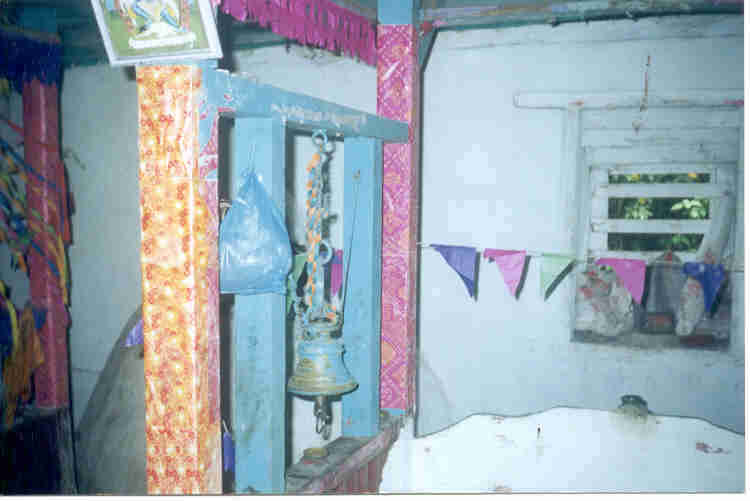
Mandir bell depict Rongli story


The historic bell (the new mandir is in the back ground)


I first wrote about this Rongli Shivalaya Mandir bell during 2003 but even to this date the mere thinking of that bell fascinates me. I never had imagined that a small article would have such impact that the old mandir was dismantled and new mandir was set which is still awaiting its completion. More than five years later when I again decided to re-write about an article on this bell I just wanted to have a first look of that antique metal piece. But this time around I was awaiting more mystery about the whereabouts of the bell. I still recall when the century old Shivalaya Mandir at the heart of the Rongli bazaar was dismantled for the renovation in 2004. The relics were kept in Rongli Police Station for safety.


This time around it was me and my cousin brother Praveen looking for that historic bell but to our surprise the personals at the Rongli Police Station was rather surprised to know that such valuable materials was actually kept at their custody. They too were interested to hear about the story of the Rongli Bazaar inscribed at a mandir bell and helped us search at their office but it was not found. They had never heard about such bell and the policemen attending on the duty had joined the Rongli Police Station only after 2004, much later than the time when the mandir properties were kept.


We were too surprised on not finding those materials and also had a talked that the New Mandir Committee might had taken back those things and kept at another secure place. It was rather more than couple of hours later to everyone’s surprise we came to know that the century old Mandir Bell was being hanged at the corner of the Hanuman Mandir at the heart of the Rongli Bazaar. Even the Mandir Committee members had forgotten about it.

When I took that metal piece on my hand I could feel the breeze of air of that era when the inscription was being under done. Still after more than five years since I last saw it, the faded blue oil paint was partly found scattered around the bell making the inscribed words bit indistinct for reading.


Let me take back to an article I wrote in a weekly newspaper “Weekend Review” published from Gangtok written in 2003 about the century old mandir at Rongli which created an impact as such the renovation and beautification of the new mandir got under.


“How often we come across, hearing of a story of a place being depicted in a bell! But this hold true at Rongli, a two-hour drive from Rangpo via Rhenock. It was Chattra Narshingh Shakyansh who in the year 1970 in one of the issue of Sikkim’s first Newsmagazine ‘Kanchenjunga’ first told the story of the then small Rongli bazaar inscribed on the bell of a century old Shivalaya mandir at Rongli. With time and development, the small hamlet changed but still today even after 30 years of the publishing of the article, the bell can still be found at the Rongli Shivalaya. This year saw another development in Rongli bazaar the old mandir was demolished and the new construction of the mandir has been set up and if there is one thing that holds its breath even now are the bell and its inscription.


Bell hanged at old Rongli Shivalaya Mandir (2003)

The inscriptions written in Nepali say that: “Rongli was a dense forest in the early days, which had a small path that lead far to Tibet. The fierce environment of the forest, the moving of the wild animals even in daylight and the rage of the ever-flowing river made the people name this place Rongli-Chu or simply Rongli or Rangel. It was in the year 1896 that a handful of Nepali and Bhutia group of people were granted an order to clear off the forest and establish a bazaar by the then Chogyal (King) Sir Thutob Namgyal. Bhim Narshingh Shakyansh was the first to construct a house and open a small shop. In 1901, a Shivling was established for religious activities and in 1917 on September 29 a temple was constructed where statue of lord Ganesha was also worshiped. There are numerous other idols inside as well.


After the British sent an expedition led by Col. Younghusband to Lhasa via Jelepla in 1903, a trade route through Rongli developed and led to many more people settle there and open shops. The youngest son of Bhim Narshingh Shakyansh, Amrit Narshingh Shakyansh along with the Rhenock Kazi Sonam Dadul and few other senior citizens were granted permission from the Sikkim government to organize a weekly haat on Sunday, which still meets every week. Selling food of mules was the chief source of money at the time when the trade route through Rongli to Jelepla functioned. Apart from these cardamoms and potatoes were also in great demand.

In August 18, 1939 Rongli bazaar witnessed its first ever landslide, which was followed by a much larger and devastating one on October 4, 1968. The landslide of 1968 changed the entire landscape of Rongli bazaar. The rocks, trees and mud entered the bazaar and the government haat ghar. Later the rocks were blasted into pieces and bulldozers were used to clear up the space that now houses the present Rongli bazaar. The death toll reached 12; bodies of eight women and four children were found. But till date the family of washer man is missing. All this is inscribed in the bell of the mandir.


It has been long time more than a century that the small path through the jungle of Rongli Chu was used as the route to Chumbi Valley. Areas of Rongli more prominent being in Gnathong, which in 1888 saw the defeat of the Tibetans, had many wars fought between the British and Tibet. The ruin forts and the war memorial are the witness that these army men had traveled through the thick fearsome jungle of Rongli to raise the British flag a landmark in history.”


I sometimes wonder did we do justice to the works of those people who had shaped the outlook of Rongli Bazaar to its present?

Friday, February 27, 2009 | By: Shital Pradhan

Sikkim University's VC meets President


The Vice Chancellor, Sikkim University, Prof Mahendra P Lama met with the President of India, Shrimati Pratibha Devi Singh Patil, who is also the Visitor of Sikkim University.

As Visitor of the University, the President of India may from time to time, appoint one or more persons to review the work and progress of the University, including Colleges and Institutions maintained by it and to submit a report thereon.

The various appointments to the highest offices of the University, like that of the Chancellor and Vice Chancellor are made by the President of India in her capacity as the Visitor of the University.

The Vice Chancellor in his meeting with Madame Patel, the President of India briefed her about the progress made by Sikkim University in these 19 months of its existence.

The President was deeply impressed by the progress made by the University and expressed her deep appreciation. She showed great interest in the affairs of the various Colleges and enquired about the students and faculty members, of both the affiliated Colleges as well as the Post Graduate Programmes being run by Sikkim University.

Shrimati Pratibha Singh Patil took this opportunity to send her best wishes to the students and teachers of Sikkim University.

Have you ever seen a boy with two head?


Such is the miracle of world that i came across a boy in a Mela at Pulbazaar (Bijanbari), Darjeeling who had two head joined to his single body. I paid him ten rupees to watch him, he was the highlight of the fair...
Tuesday, February 24, 2009 | By: Shital Pradhan

Zaluk Yeti Search Photo Feature

Zaluk

The valley where the animal man was spotted

Nar Bhadhur Sunar (eye witness)


The team we had L.T Bhutia, Swarup Rai,Nar Bhadhur Sunar, Pranay Pradhan, Beren Gurung and Praveen Pradhan (Well i was the photographer here)


Friday, February 20, 2009 | By: Shital Pradhan

Yeti sighted at Zaluk, Sikkim in 2004


BY SHITAL PRADHAN


I was at Zaluk last friday, the day most of the couples across the globe was busy celebrating Valentine Day. More or less an exciting adventure was awaiting us when we came to know that there was a Yeti sighting at this remote place in 2004 on the month of April. Zaluk is a small place where the population is below 300 and the world famous Changu Lake is an hour and half drive from Rongli Bazaar.

We were five member team myself, Praveen, Rocky, Swarup and Beren. The video above is a short interview i took where the prime eye witness Nar Bhadhur Sunar confirms that he along with other 10 labourers and a GREF Officer had came across a Yeti in the April of 2004 while going for the daily work. Sunar a farmer now was a working as a baidar then. They were on a vehicle and the "animal man" as he called was on the other side of the road along the Valley walking on two feets along the bushes of pareng ( a bamboo variety). The distance between them was around 200 to 250 metre. They saw the back portion of the animal for over half an hour and suddenly it vanished around the bushes.

It was noted that for over few days the army helicopter did had a vain search over that particular region but nothing more could be known. Such incident was not known till then and also not heard after that but the people of Zaluk also has confirmed that on particular times they do hear of strange voices coming from the nearby valley.

Well the people who saw it claims it to be a "Sokpa" as Yeti is better called in this part of land. For them that animal was not a bear as it is commonly found in that region and they could identity with it. Another interesting part of the story is that after few days of the incident the villagers did found a foot steps on the marshy land near the over flowing water that were measured something like "from an elbow joint to a finger tip" long.

Nar Bhadhur Sunar told a water pipes was recovered by the villagers along the bushes inside the forest that was crushed and thrown away from the water source that no man or any other animal could do it. We talked with Jeena Chettri, daughter of Nar Bhadhur Sunar who added that the animal was dragging his feet as such they could not realized whether the animal had its feet the opposite side as it is normally believed. The "thing" had black hair covered all over the body and the length of the hair was as such it looked as if a women had let free her hair, told Jeena in her own words. Those GREF workers whistled and made sound to that animal that it hurried inside the bushes, she added.

Well it is too early to say that the animal man those people claimed was not the mysterious Yeti that the whole world is searching for. I had gone through the wrinkled face and the piercing eye of the man who was in his mid sixties and do believe in his word that the thing he saw along with his daughter and his fellow workers was a Yeti. I do believe him that he could differentiate a bear from an animal they had never seen before that they believed look more like a human.